
Every commentary I bought said "meaning uncertain" next to the same verse until I found out the explanation wasn't missing, it was removed.
I was in a men's Bible study group. Tuesday nights. We'd been meeting for three years. Going through the New Testament verse by verse.
We got to Jude. Fourteen verses into this tiny book, someone read verse 14 out loud.|
"Enoch, the seventh from Adam, prophesied about these men: 'See, the Lord is coming with thousands upon thousands of his holy ones.'"
The guy leading the study paused. Looked up from his Bible.
"Wait. Which book is that from?"
We all flipped to the table of contents. Genesis. Exodus. All the way through Malachi. No Enoch.
I pulled out my phone. Googled it right there at the table.
"The Book of Enoch. It's not in the Protestant Bible."
Silence.
Then someone said, "Well, if it's not in the Bible, why is the Bible quoting it?"
Good question.
The leader smiled. Moved on. "Let's not get sidetracked. The point of the passage is about false teachers."
But I couldn't let it go.
If Jude—an apostle, the brother of James, writing under divine inspiration—quoted this book by name and called it prophecy, how is it not scripture?
I went home that night and started digging.
Turns out Jude isn't the only one. Peter references it. Paul alludes to it. Jesus Himself used language that echoes Enoch when He talked about the "Son of Man."
The early church fathers quoted it constantly. Tertullian called it scripture. Irenaeus referenced it. Clement of Alexandria cited it in his writings.
For the first 400 years of Christianity, the Book of Enoch was considered authoritative.
Then it disappeared from Western Bibles. Not because scholars proved it was false. Not because new evidence emerged. It just... stopped being included.
I found out that the Ethiopian Orthodox Church never removed it. They've had the same 88-book Bible for over 1,500 years. Same collection. No edits. No deletions.
While Europe was fighting over which books belonged and which didn't, Ethiopia just kept reading the Bible they'd always had.
The same Bible that predates the Council of Nicaea. The same Bible that the Ethiopian eunuch in Acts 8 would have known when Philip baptized him.
And they didn't just keep the extra books. They kept God's true name — Yahweh — on every page. The same name that was stripped out of the King James Bible over 6,800 times and replaced with "Lord."
That hit me differently than the Dead Sea Scrolls revelation hit some people.
Because Ethiopia didn't just preserve Enoch. They preserved Jubilees, which explains the entire Genesis timeline. They preserved the Wisdom of Solomon, which Paul quoted in Romans. They preserved 1 Maccabees, which explains where the Pharisees came from and why the Jewish world looked the way it did when Jesus arrived.
These aren't random religious texts. They're the books the apostles read. The books Jesus studied. The books that make the gaps in the Old Testament finally make sense.
And when the Dead Sea Scrolls were discovered in 1947, the oldest biblical manuscripts ever found didn't match the western Protestant Bible.
They matched Ethiopia's.
For 2,000 years, the world read 66 books while Ethiopia quietly protected all 88. Not because they were heretics. Because they were never conquered. The only Christian nation never colonized by a foreign power. The only nation that claims to guard the Ark of the Covenant to this day.
I started noticing things I'd always glossed over.
Genesis 6 mentions the Nephilim—giants born when the "sons of God" married human women. Then it just moves on to the flood. No explanation. No context.
For years, I'd heard the "sons of Seth" interpretation. That the "sons of God" were just the godly line of Seth marrying the ungodly line of Cain.
It never made sense. Why would that produce giants? Why would that cause God to destroy the world?
The Book of Enoch explains it. In detail. Names the angels who fell. Describes what they taught humanity. Explains why the flood was necessary.
Suddenly, Genesis 6 wasn't a confusing fragment. It was the summary of a much longer story.
Hebrews 11 mentions people who were "sawn in two" for their faith. That story isn't in the Protestant Old Testament. It's in the Apocrypha.
Paul talks about the "pillar of cloud" and the "spiritual rock" that followed Israel. Those details come from Jubilees and the Wisdom texts, not from the five books of Moses alone.
The New Testament assumes you know these books.
But I didn't. Because they weren't in my Bible.
I brought it up again in the men's group a few weeks later. Tried to be casual about it.
"Has anyone ever read the Book of Enoch? I've been looking into it."
One guy said, "I think that's the one with all the weird angel stuff. Probably not inspired."
Another said, "If God wanted us to have it, it would be in the Bible."
But how do you know God doesn't want you to have it when the apostles clearly had it and quoted it?
I felt stuck. I wanted to read these books, but every version I found online felt wrong.
The academic translations were dense and unreadable. Footnotes longer than the verses. Written for scholars, not for people who just wanted to understand their faith better.
The "sacred name" Bibles replaced every familiar word with Hebrew transliterations I couldn't pronounce. Jesus became Yahusha. Lord became Yahuah. It felt like joining a different religion just to read a book.
The cheap print-on-demand versions had microscopic fonts and paper so thin you could see through it. They felt like bootleg copies.
Amazon was flooded with counterfeits. Missing chapters. Pages that conveniently skipped the most important parts. Versions that claimed to be "complete" but weren't even close.
I wanted something readable. Something complete. Something that treated these texts with the respect they deserved.
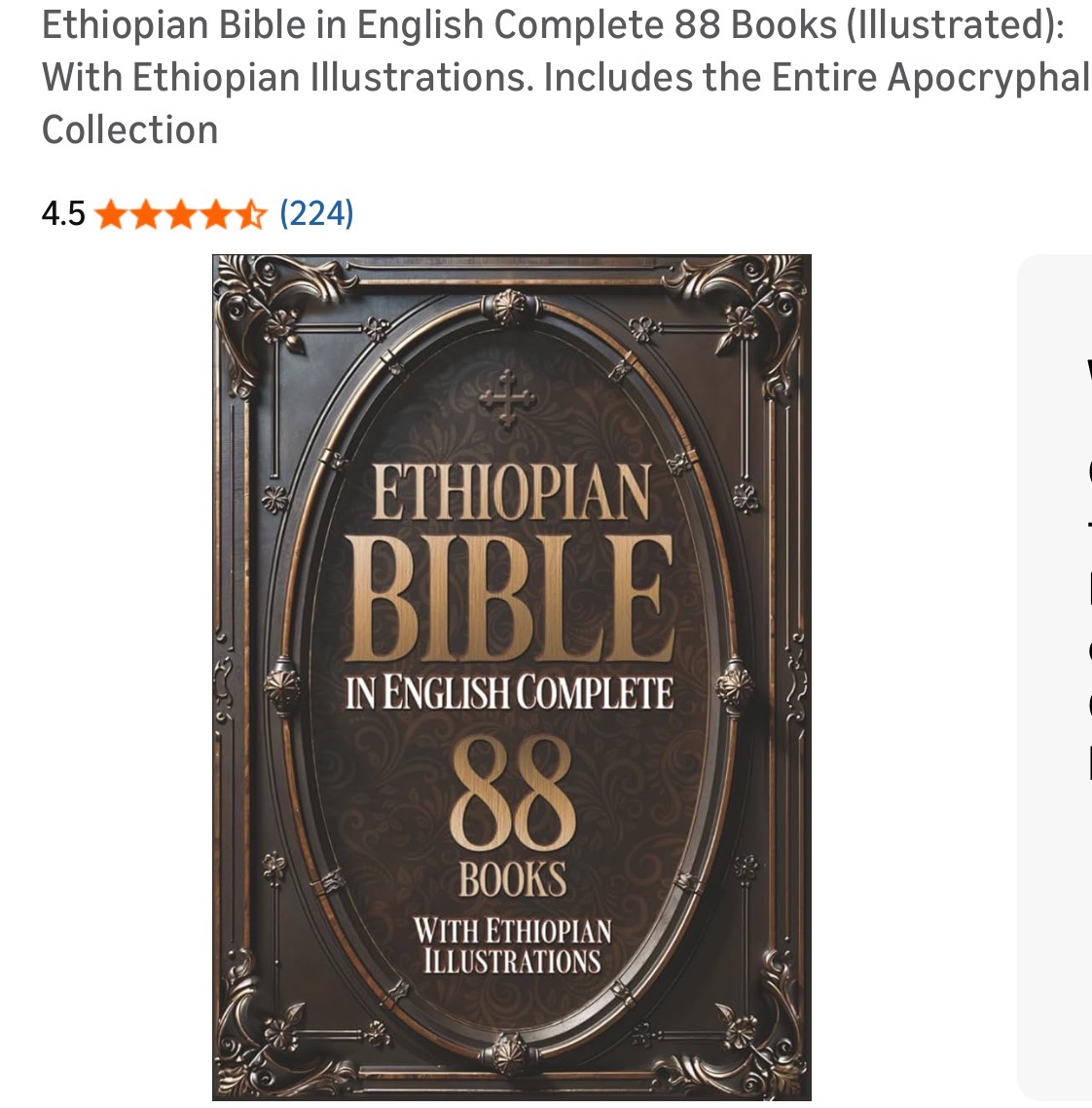
Then I found the Complete Ethiopian Bible by The Living Word.
It wasn't being pushed by some YouTube conspiracy channel. Just a straightforward description. The full 88-book canon used by the Ethiopian Orthodox Church. Modern English. Actual readable formatting. Nothing removed. Nothing edited. Nothing censored. Yahweh's true name on every page, not replaced with "Lord."
I read the reviews. Over 15,000 people had already ordered it. People said it was clear, faithful, and respectful. It wasn't trying to replace anything. It was offering the full library.
I ordered it.
When it arrived, I didn't tell anyone at first. I felt like I was doing something I shouldn't be doing, even though I knew that was ridiculous.
The first night, I opened to the Book of Jubilees.
It's basically an expanded version of Genesis. It gives you the timeline. The dates. The names of people who aren't mentioned in Genesis but who mattered to the story.
It explained why Abraham knew to sacrifice Isaac on Mount Moriah. It explained where the demons came from. It explained the calendar the Israelites used and why the feasts fell on the days they did.
It wasn't strange or mystical. It was just... more detail. The kind of detail that makes the rest of the Bible make sense.
I kept reading. The Wisdom of Sirach felt like Proverbs on steroids—practical wisdom about family, friendship, work, and honoring God.
First Maccabees was a historical narrative that explained the 400 years between Malachi and Matthew. It showed how the Pharisees and Sadducees formed. It showed why the Jewish people hated Roman occupation so much by the time Jesus arrived.
These weren't "extra" books. They were the missing chapters.
A few weeks later, I finally read Enoch.
The book Jude quoted. The book found in the Dead Sea Scrolls. The book the early church used.
It described the rebellion of the Watchers—200 angels who descended on Mount Hermon and corrupted humanity. It named them. Azazel. Semjaza. Baraqiel.
It explained what they taught: sorcery, astrology, weapon-making, cosmetics. The knowledge that led to the violence and corruption that required the flood.
It described Enoch's tours of heaven and hell. The chambers of the winds. The tree of life. The place where the spirits of the dead wait for judgment.
And it prophesied about the Messiah—the "Son of Man" who would come with thousands of holy ones to execute judgment.
The exact prophecy Jude quoted.
Suddenly, when Jesus called Himself the "Son of Man" over and over in the Gospels, it wasn't just a humble title. It was a claim. He was identifying Himself as the figure Enoch saw in his visions.
I didn't know it. Because I didn't have the book.
The Bible I'd been reading my whole life wasn't wrong. It just wasn't complete.
Like watching a movie where someone edited out the first act and all the flashback scenes. You can follow the plot, but you miss half the meaning.
I still love the King James Version. I still read it. I'm not trying to replace it.
But now I also read the books the apostles read. The books that were in the Dead Sea Scrolls. The books that Ethiopia never removed. The books with God's true name still on every page.
And I don't feel like I'm reading the Western church's version of the faith anymore.
I feel like I'm reading the faith.
Last month, the guy who leads our Bible study asked if he could borrow the book. He'd been thinking about our conversation. About Jude quoting Enoch.
"I just want to see what it says," he told me.
I lent it to him.
A week later, he texted me a link. He'd ordered his own copy from The Living Word.
I'm not here to tell anyone their Bible is wrong. I'm not trying to start some movement.
I just know what I found.
The Bible quotes books that modern Protestantism doesn't include. The apostles used texts we don't have. The Ethiopian church preserved a canon we abandoned. And when the oldest manuscripts in existence were finally discovered, they matched what Ethiopia had been protecting all along.
And when I read the complete collection, the Bible I've loved my whole life finally made complete sense.
Not different sense. Complete sense.
If you've ever wondered why Jude quotes a prophet you've never heard of, or why the apostles reference stories that aren't in your Old Testament, or why there's a 400-year gap between the testaments that nobody explains, you're not alone.
The answers exist.
They've been preserved. In Ethiopia. In the Dead Sea caves. In the ancient manuscripts the early church used.
Someone just decided, a long time ago, that you didn't need them.
I needed them.
And now I have them.
If you want to read the same complete scripture, here's what I'd tell you.
The version I found — the Complete Ethiopian Bible by The Living Word — is the only one I've seen that gets it right. All 88 books. Nothing removed. Nothing edited. Yahweh's true name on every page, not replaced with "Lord."
It includes the Book of Enoch — the one Jude quoted. Jubilees. Maccabees. Sirach. The Wisdom of Solomon. Every text I mentioned above. The books the apostles quoted. The books that make the 400-year gap finally make sense.
The Living Word is a small publisher. No corporate backing. No big distribution deal. Just one woman who believed people deserved access to the complete canon and not just the version that survived budget cuts and printing shortcuts.
She's selling it for a fraction of what it normally costs. Not to make money, but because she believes more people should have it.
Over 15,000 people have already ordered their copy. Every order comes with a 90-day money-back guarantee. If you read it and it doesn't change the way you understand scripture, send it back. No questions asked.
I'll leave a link to their website below 👇🏻
https://thelivingword.shop/pages/ethiopian-5
Here's the only thing I'd flag: The Living Word is a small operation and these aren't mass-produced. They restock in batches, and I've seen them sell out more than once. If the link above works, copies are available. If it doesn't, they'll restock in about two months.
I'm not in a rush to pressure anyone. This isn't that kind of post.
But if you've ever sat in a Bible study and heard someone quote a verse from a book that isn't in your Bible — and nobody could explain why — the answer is in this book.
It's been there for 2,000 years.
Someone just kept it from you.
I'll leave the link below 👇🏻
https://thelivingword.shop/pages/ethiopian-5
P.S. I'm not paid to write this. I'm not affiliated with The Living Word. I'm just a Christian who spent decades reading the abridged edition and didn't know it. I want other people to have what I found.
Pastor Micah Wells, Facebook
No comments:
Post a Comment
Thanks for sharing. Blessings on your head from the Lord Jesus, Yeshua HaMashiach.
Steve Martin
Founder
Love For His People
Charlotte, NC USA