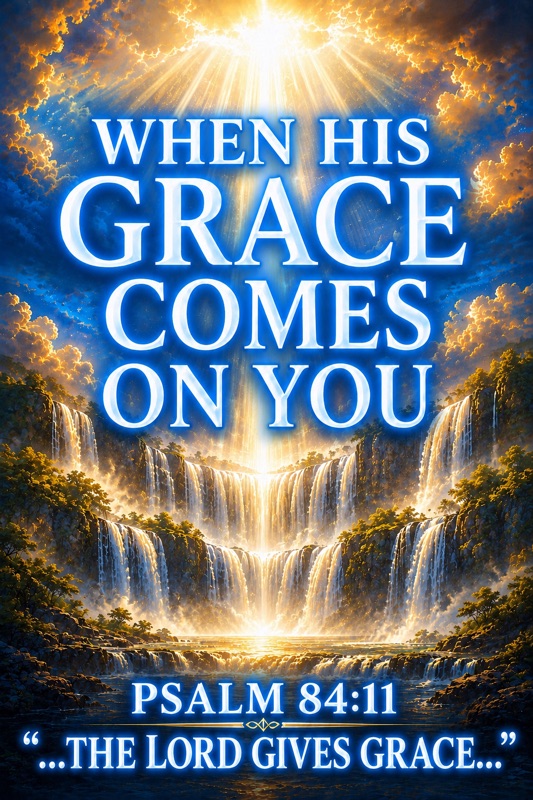
Remember those times when you get “in the groove” - you feel like baking a whole lot (some people do, like Laurie in the winter); you have extra energy to finish three loads of laundry (ugh!); you mow the yard for an hour and you can do it again, as the sweat pours through your soaked t-shirt…
Well friend, that is how it is with me in writing or designing new book covers. The Holy Spirit gives you that grace to push on and do more.
Particularly after I have spent some time praying in tongues.
When The Grace Comes On You is a special time.
“For the Lord God is a sun and shield; The Lord gives grace and glory; He withholds no good thing from those who walk with integrity.” Psalm 84:11
There are certainly “seasons of the soul” – those times in the spiritual which seem like a spring time of refreshing; summer months of growth and sun; a fall of coolness and colorful beauty; and a winter of dry days and maybe even darkness within and without.
Each of us have had them, and continue to. They help us keep our spiritual balance and seeking our Lord.
Not every day can be a mountain top experience, nor will we have ongoing desert periods, similar to what Yeshua (Jesus) walked through before His major anointing came down.
When His grace comes on you, it is do accomplish His will, His purpose, for your good and those He has sent you to share it with. His abundant and available grace comes because of His Love, His provision, His ongoing care for people.
He wants to, and does, use us, enables us, challenges us even to do so.
When His grace comes to you, do what He blesses you to do. Share His Grace with others, and experience part of His manifest love He has for His world.
“For God so loved…” Yes He did, and daily continues to pour out His grace upon you and me.
“And the firstling of an ass thou shalt redeem with a lamb; and if thou wilt not redeem it, then thou shalt break its neck. All the firstborn of thy sons thou shalt redeem. And none shall appear before Me empty.” (Exodus 34:20)
The firstborn donkey redeemed in a rare Biblical ritual on Mt. Zion. (Courtesy Behadrey Haredim)
There are many Torah commandments (mitzvot) that even the most observant Jew living outside of Israel will never see or perform. Some of these mitzvot are making a comeback and having a most unanticipated effect.
Last Saturday night, a baby donkey was brought to the Tomb of King David on Mount Zion to be redeemed. What many consider an obscure agricultural ritual turned into a joyous celebration that ended with passionate cries for the coming of the Messiah.
Petter Chamor (redeeming a firstborn donkey) is mentioned three times in the Torah (Exodus 13:13; Exodus 34:20; Numbers 18:15). Redeeming the firstborn donkey is necessary since, when it is born, it is considered Hekdesh, or sanctified, and belonging to God via his emissary, the kohen, or high priest. The owner of the donkey’s mother has the right to use the donkey after he redeems it by giving a sheep to the priest in its place.
The story begins with a man from Bnei Berak who owned a jenny – a female donkey – which gave birth to a foal. He approached Rabbi Berger, the rabbi of King David’s Tomb, which is located in Jerusalem’s Old City.
Rabbi Berger told Breaking Israel News that the man wanted to redeem the donkey in the place that symbolizes the unity of Israel under one king. As Rabbi Berger explained, “This is the place where the entire nation of Israel will be redeemed, so it is only fitting.”
Redeeming of the firstborn donkey. (Courtesy Behadrey Haredim)
The rabbi was thrilled by the prospect of performing the rare commandment, and arranged for it to be done at the most auspicious time for the Kingdom of David: Saturday night after the Sabbath ends. A special feast, accompanied by music, is usually held at that time at the Tomb of David, but with the addition of one tiny foal, this became an extra-special occasion.
Rabbi Simcha Hacohen Kook, Chief Rabbi of Rehovot and the Hurva Synagogue in Jerusalem, served as the kohanic emissary to receive the young donkey. Other esteemed rabbis, among them Rabbi Aharon Yitzchak Stern and Rabbi Shalom Arush, attended the ceremony as well.
The small donkey was decorated and adorned with a crown, since, as Rabbi Berger explained, “This donkey, by bringing about this mitzvah, connects us to God, so it is fitting we should honor it and make it beautiful.”
Alongside the donkey stood a sheep that would be given in its place to redeem it. The owner of the donkey stood in front of Rabbi Simcha Hacohen Kook, and requested to redeem the donkey.
He then recited the blessing:
Blessed art thou, King of the universe, who has sanctified us with his commandments, and commanded us to redeem the firstborn donkey.
Redeeming of the firstborn donkey. (Courtesy Behadrey Haredim)
Then he recited the blessing of shehechayanu, a blessing which is said on special occasions when one is celebrating a “first”. The blessing thanks God for sustaining the reciter until this auspicious moment.
Document attesting to the redemption and “exchange” of the donkey. (Courtesy Behadrey Haredim)
Rabbi Berger described the great excitement of the gathered crowd when they heard the rare blessing. Those gathered chanted together, “God, just as you redeemed this donkey, please redeem all of Israel and bring moshiach (messiah) now!”
Breaking Israel News asked Rabbi Berger about the significance of the mitzvah. He explained that it was connected to the Exodus from Egypt, which is one of the major principles of Judaism.
“The Torah says that we do the mitzvah of redeeming the firstborn of a donkey in memory of the final plague in Egypt, in which the firstborn of Egypt were killed (Exodus 11:5). We know that every Jew who has a first-born son must redeem him for this reason as well,” Rabbi Berger said.
The rabbi explained why the donkey, out of all the animals, was chosen for remembering the Exodus. “The Talmud (oral law) says that the mitzvah is a reward for the donkey, a merit it is given through helping Israel connect to God,” he told Breaking Israel News. “It earned this reward by helping Israel carry the Jews and all the wealth out of Egypt. In the Torah, gratitude is very important, so we must show gratitude to the donkeys that carried us out.”
Redeeming of the firstborn donkey. (Courtesy Behadrey Haredim)
In these days which seem to clearly be paving the way for the messiah, it is exciting to see that every creature, great and small, will play a part.
An attendee takes a selfie with the redeemed donkey. (Courtesy Behadrey Haredim)
The gathering celebrates after the redemption of the donkey. (Courtesy Behadrey Haredim)