British General Edmund Allenby enters Jerusalem on December 11, 1917. Only days earlier, the city was still under the administration of the Ottoman empire, a 400-year-long occupation. Library of Congress.
Israel's History - a Picture a Day (Beta) - The Holy Land Revealed
Aug. 4, 2017
This year marks the 50th anniversary of Jerusalem’s unification in the Six-Day War. It also marks the 100th anniversary of a fierce World War I battle that saved the city from destruction.
A version of this article appeared in
Mosaic, May 22, 2017
Posted: 04 Aug 2017
On Yom Yerushalayim [Jerusalem Day], which took place on May 24, 2017, Israel celebrated the 50th anniversary of Jerusalem’s unification in June 1967. Marking the climax of a swift defensive victory over the armies of Egypt, Syria, and Jordan, the battle for the Holy City resulted in dramatically altering its political, religious, and geographic status.
But this year also marks another anniversary: the centenary of a fierce World War I battle that not only saved Jerusalem from physical destruction but rescued its entire Jewish population from squalor, starvation, plague, exile, and death. In the scope of Jewish history, the liberation of Jerusalem in December 1917 ranks with the salvation holidays of Hanukkah and Purim.
Origins
Early in World War I, with the encouragement of its German allies, the Ottoman army in Palestine began preparations to attack British positions along Egypt’s Suez Canal, a critical artery linking Great Britain to its colonies in the east. The attack took place in January 1915.
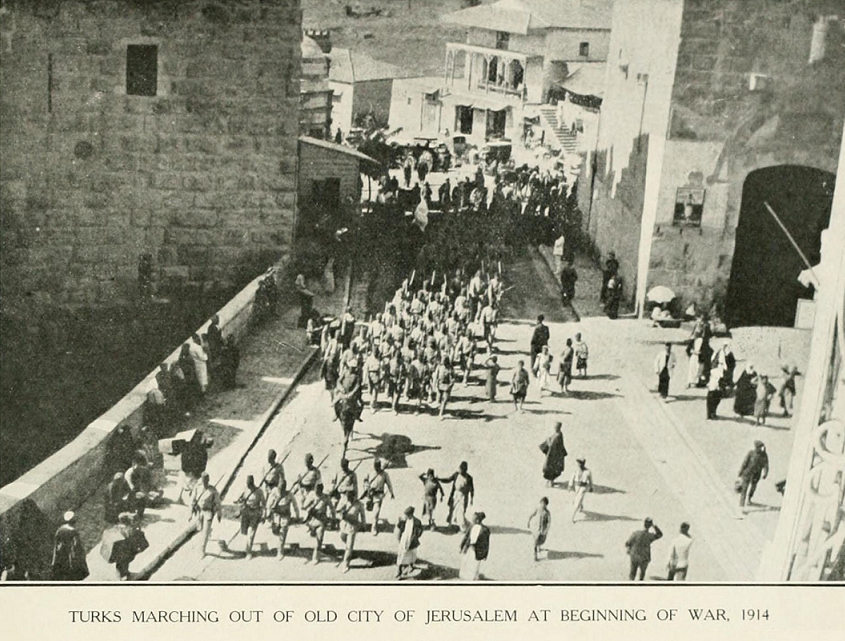
 Turkish troops passing through the Jaffa Gate, 1914. From the author’s collection, Ottoman Imperial Archives. Click all images to enlarge.
To bolster their forces, the Turks declared universal conscription in Palestine, a territory that had been under Ottoman control since the late 15th century. Supplies, livestock, and equipment were plundered from the local population. A letter to an American supporter from the American Colony, a community of Christians in Jerusalem, summed up the situation in the city and the country at large:
[The Turkish] government commandeering not only animals but every requirement of life, the wholesale drafting of the manpower, and the dearth of business, since being entirely cut off from communication with the outside world—all of these things [have] brought people to an unbelievable state of poverty.
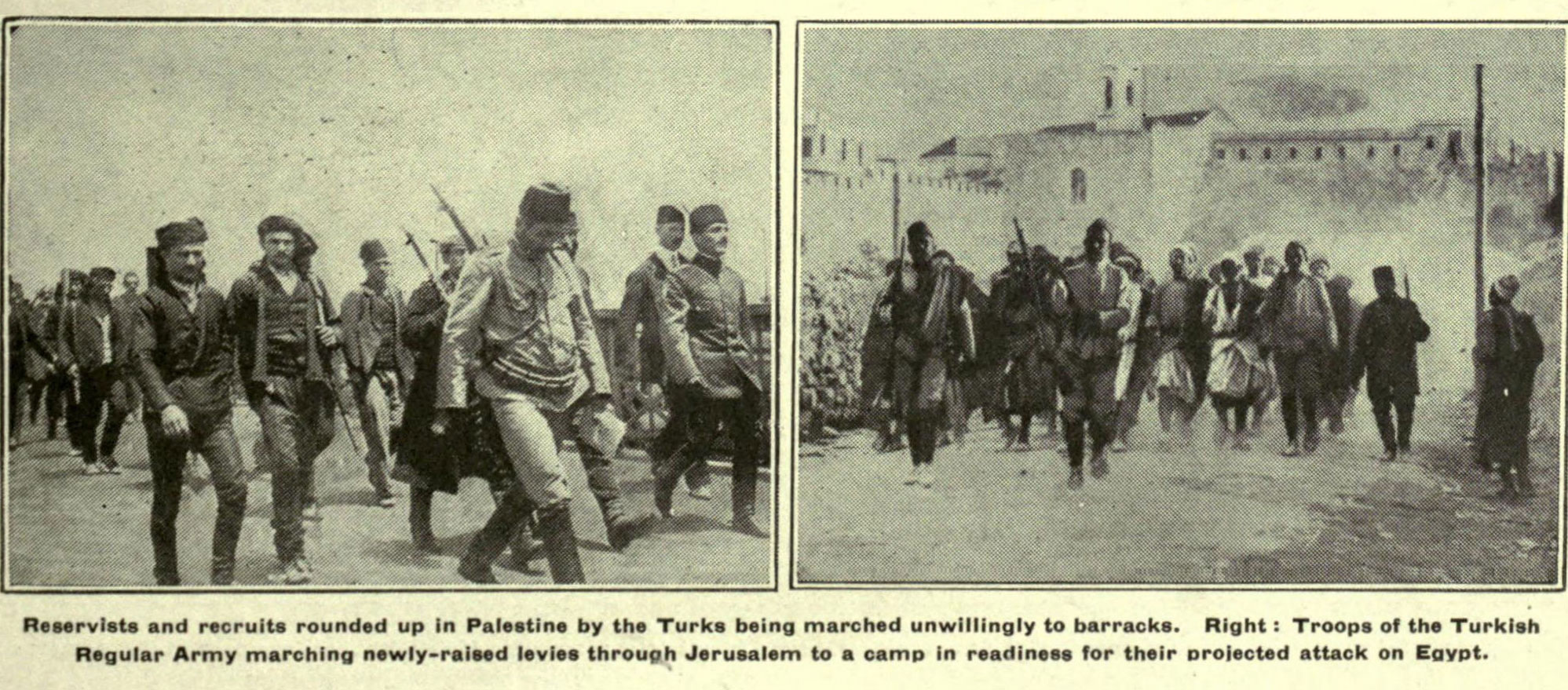
Jews, who already then constituted a majority in modern Jerusalem, were especially hard hit as Jewish men were rounded up and sent to the front lines. On August 31, 1914, the American ambassador to Turkey, Henry Morgenthau, sent an urgent telegram to the New York Jewish tycoon Jacob Schiff. “Palestinian Jews facing terrible crisis,” he wrote. “Fifty-thousand dollars . . . needed [to] support families whose breadwinners have entered army.”
 Caption reads: “Reservists and recruits rounded up in Palestine by the Turks being marched unwillingly to barracks. Troops of the Turkish Regular Army marching newly-raised levies through Jerusalem to camp in readiness for their projected attack on Egypt.” From the author’s collection, Ottoman Imperial Archives.
Nature Takes a Hand
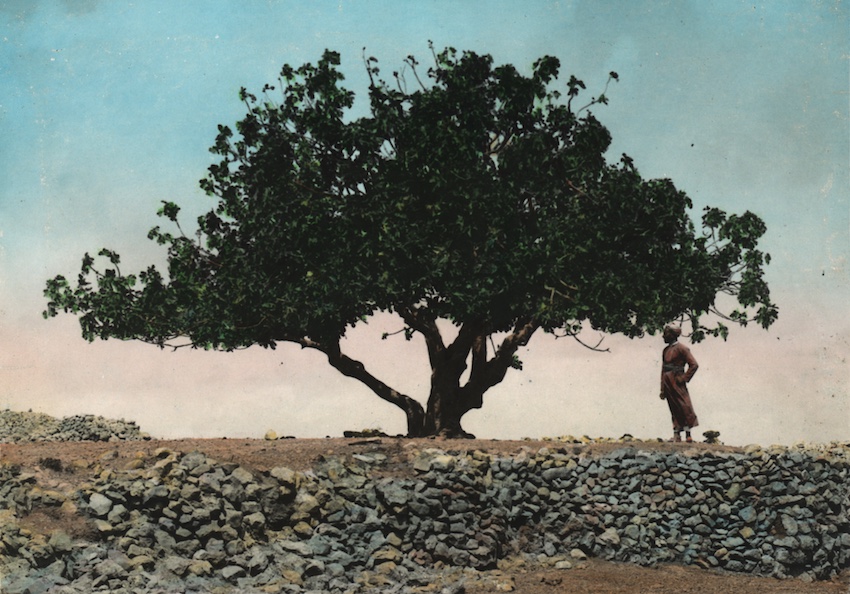
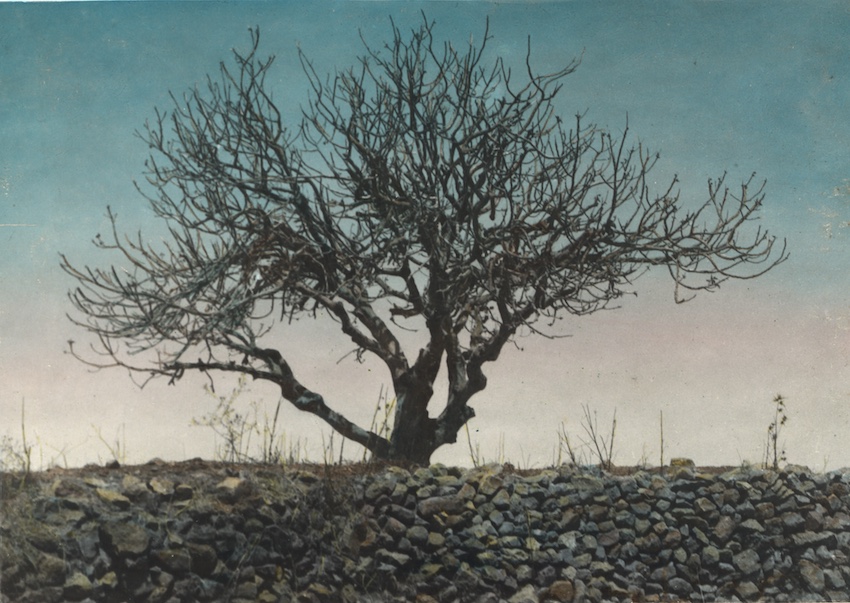
Matters turned even worse when, starting in March 1915, huge swarms of locusts struck Syria and Palestine, devastating the countryside, devouring everything in sight, and spreading disease and starvation on a massive scale. “The locust invasion started seven days ago and covered the sky,” wrote the Muslim Jerusalemite Ihsan Hasan al-Turjman in his diary on March 29, 1915. “Today it took the locust clouds two hours to pass over the city. God protect us from the three plagues—war, locusts, and disease—for they are spreading through the country. Pity the poor.”
In the words of John Whiting, an American Colony member who chronicled the locust cycle in a series of photographs, “The locusts were so voracious and numerous that they could swarm over an unguarded infant and devour its eyes within a few minutes.” For his part, the Zionist activist Alexander Aaronsohn reported seeing “Arab babies, left by their mothers in the shade of some tree, whose faces had been devoured by the oncoming swarms of locusts before their screams had been heard.”
 A tree before the locusts struck. Library of Congress.
 The same tree minutes later after the locusts hit. Library of Congress.
Between late 1915 and late 1916, according to one analyst, somewhere between 100,000 and 200,000 people in Palestine died “from starvation or starvation-related diseases” caused by the locust invasion. In Jerusalem, some Jewish women, desperate for food and care for their children, and not knowing the fate of their husbands, turned to prostitution and, as one historian has written, “went to the wrong with German and Turkish troops.”
The Turks Bear Down
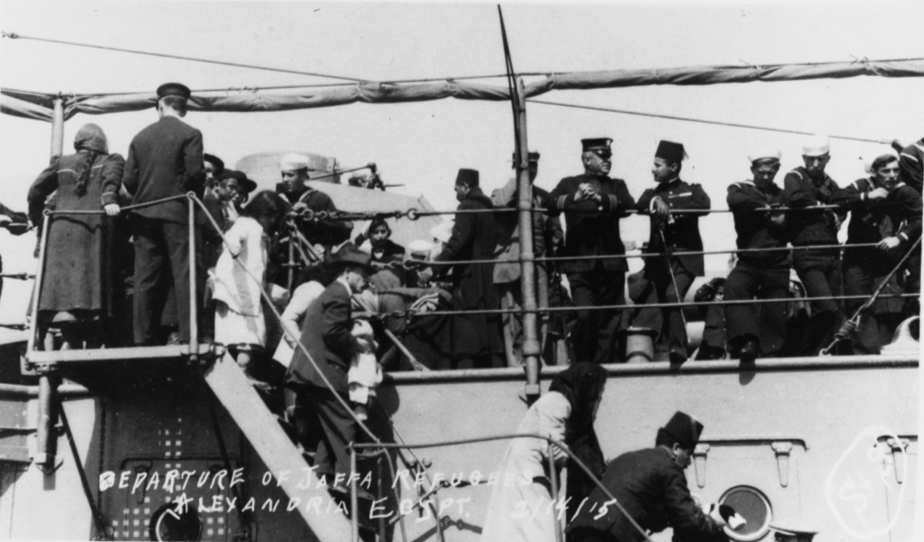
Across Palestine, the Turks ruled with cruelty and rapaciousness. All suffered, but especially Jews and Armenian Christians. Since Russia was part of the alliance ranged against Germany and the Ottoman empire, Jews of Russian origin were viewed as a potential fifth column. In December 1914, the Turks expelled 6,000 of them from Jaffa. (Thanks to the U.S. Navy, they were safely evacuated to Alexandria.) In April 1917, another 8,000-10,000 Jews would be expelled from Jaffa and Tel Aviv.
 Expelled Jews arriving in Alexandria, Egypt, in late 1914 or early 1915 on the USS Tennessee. Department of the Navy, Naval Historical Center.
Ḥemdah Ben-Yehudah, a journalist and the wife of the pioneering Hebrew scholar Eliezer Ben-Yehudah, provided further details in her lengthy contribution to Jerusalem: Its Redemption and Future, a 1918 volume of eyewitness essays:
The [Turkish] military commander Hassan Bey knew no limits to . . . wickedness. The [Turks] began by a systematic persecution of the Jews. They arrested the Hebrews; cross-questioned them; accused them of concealing arms, of evading military service, of belonging to secret societies, and of working in opposition to the government. After being cast into prison, they were spit upon, beaten, deprived of their watches and money, fined heavily, and then released! . . .
[O]n pretext of military necessity the government took possession of the remaining supplies in the city and occupied public buildings that belonged to enemy countries [i.e., Britain, France, and Russia], the hospitals, orphanages, schools, convents, and monasteries.
Ten-thousand Jews left Jerusalem in one week. The streets were filled with the exiles who had no carriages and conveyed their baggage on their own backs.
Most of the houses were closed because the inhabitants were dead, or deported, exiled, or in prison. Deserted were the streets. One dreaded to be seen outdoors for fear of falling victim to the rage of the Turks. The women kept house underground; but there was little food to prepare. They had forgotten the appearance of a loaf of bread. The babies died for lack of milk.
Fervent prayers were rudely interrupted by the intrusion of Turkish soldiers [who] entered and penetrated down to the cellars and arrested the defenseless Hebrews. They tore the husbands from the arms of their wives, and separated the children from their parents. . . . The wives and the young women threw themselves upon the necks of their husbands and fathers and brothers, insisting that they should share the horrors of this terrible forced journey. The victims were taken away in the direction of Jericho.
The Tide Starts to Turn
By summer 1917, the city of Jerusalem and its Jewish residents were nearly eradicated. Some 2,700 orphans wandered the streets. The weakened population fell victim to cholera, tuberculosis, and typhoid.
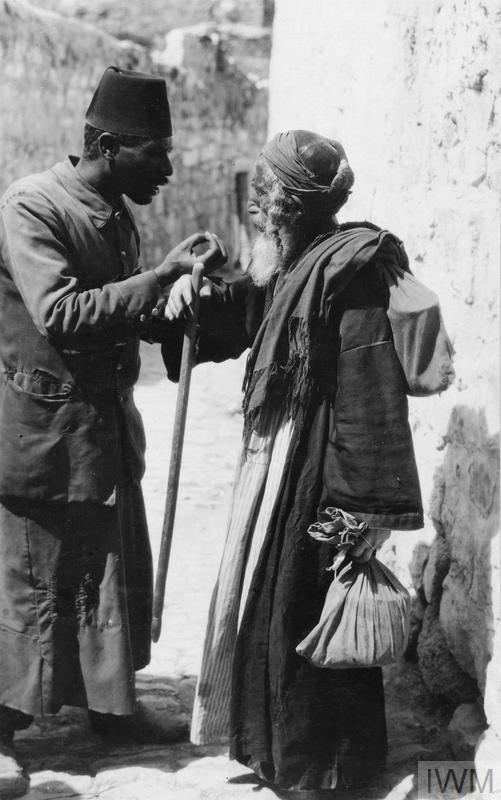
A harassed Jewish beggar in Jerusalem. The photo, taken by a German officer, bore the caption: “a typical merchant in a Jerusalem street market, 1917.” Imperial War Museum, Q 86351.
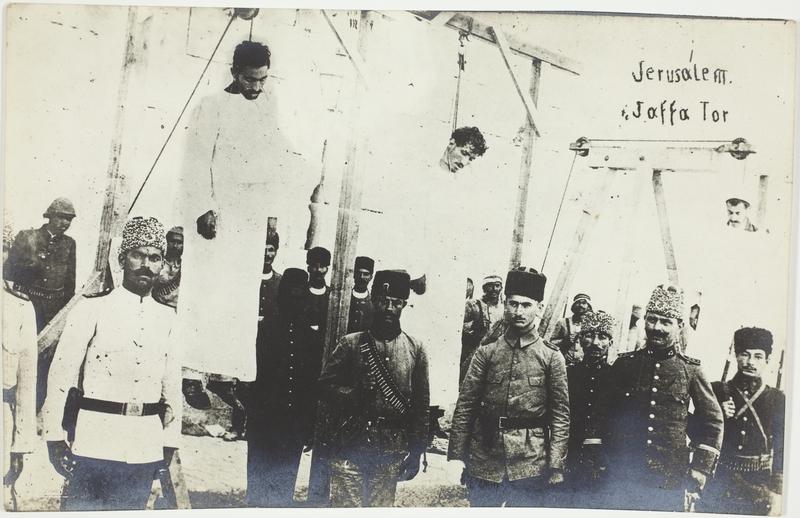
 Original caption: “Hangings outside Jaffa Gate, Jerusalem: Arabs, Armenians, Bedouins, Jews.” Official Turkish photo circa 1917. File number FL1533796. State Library, New South Wales, Australia.
But by now the Turks were coming under increasing pressure from the British expeditionary force led by General Edmund Allenby. Having repulsed the attempted Ottoman invasion of Egypt, Allenby was moving northward to Gaza and posing an incipient threat to the Turkish grip on Jerusalem.
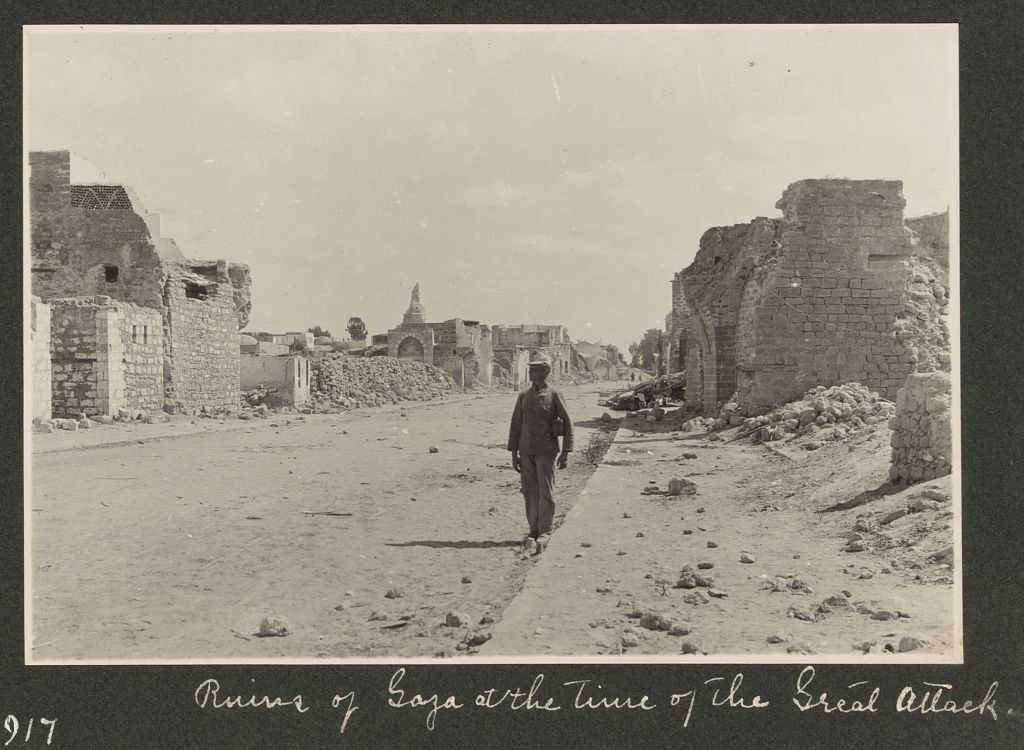
“Scorched earth” is an apt description of some of the Turkish-British battle sites in Palestine, as can be seen in images of the devastation following the fierce fighting in Gaza in the spring of 1917:
 Gaza after the two battles in March and April 1917. Library of Congress.
After capturing Be’er Sheva in October, the British forces, supplemented by fighters from Australia and New Zealand (known as ANZACs), turned toward Jerusalem.
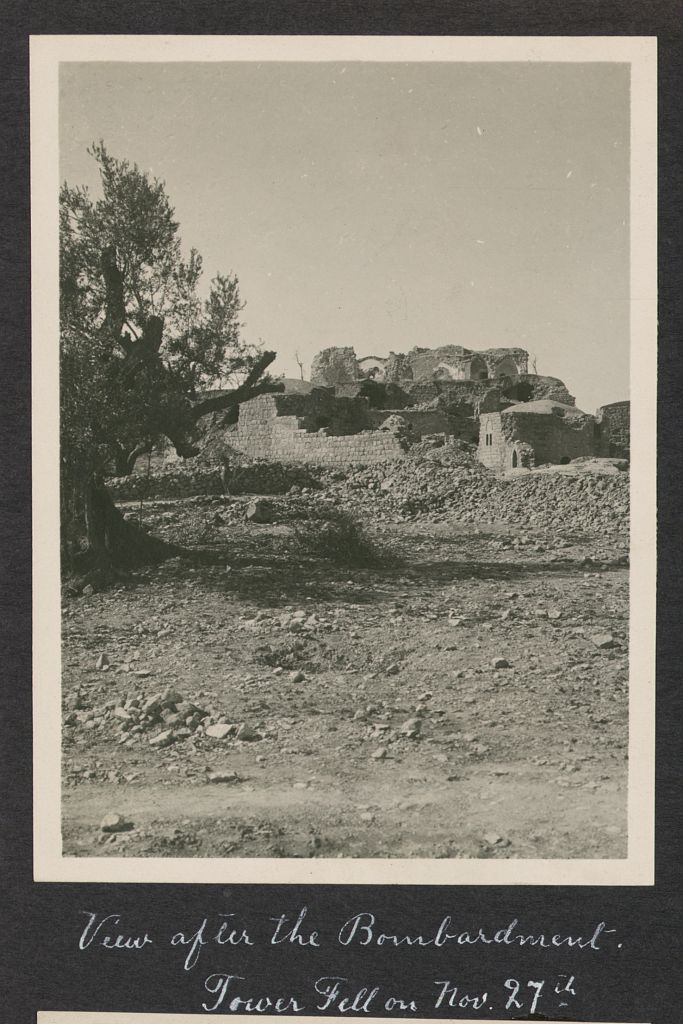
The prominent hilltop of Nebi Samuel (tomb of the Prophet Samuel, which had been converted into a mosque), just three miles north of Jerusalem, was the scene of a November battle between three British and three Turkish divisions. Ḥemdah Ben-Yehudah describes hearing, even from her cellar hiding-place, “the roar of Turkish cannon . . . against the Nebi Samuel where the English had fortified themselves.” It, too, was reduced to ruins:
 Nebi Samuel before the battle. Library of Congress.
Nebi Samuel after the battle. Library of Congress.
The Redemption of Jerusalem Begins
A Turkish scholar describes what happened next, after the Turks appealed to their German allies for help in defending Jerusalem:
The German General Erich von Falkenhayn did not send reinforcements to Jerusalem because he did not want the relics and the holy places damaged because of severe fighting. . . . Dissatisfaction with the advice and command of General Falkenhayn was growing. His inability had resulted in the loss of the Gaza-Beersheba line. His refusal to send reinforcements would now result in the loss of Jerusalem. . . .In fact, Falkenhayn, the commander of the Turkish and German armies in Palestine, not only refused to send reinforcements but ordered the retreat of Turkish soldiers so that Jerusalem would not be destroyed. From her own vantage point, here is how Ḥemdah Ben-Yehudah saw it:
The English were making a movement whose object was to encircle Jerusalem. The Turks and Germans commanded that the city should be defended and they sent for reinforcements from Damascus. . . . When the reinforcements failed to arrive, the Turks perceived that they would be obliged to evacuate. In great haste, they arrested everyone whom they caught on the streets. . . . For the last time on leaving, the hated Turkish soldiers had entered the houses to rob and to spoil, and to carry off everything they could lay hands on.
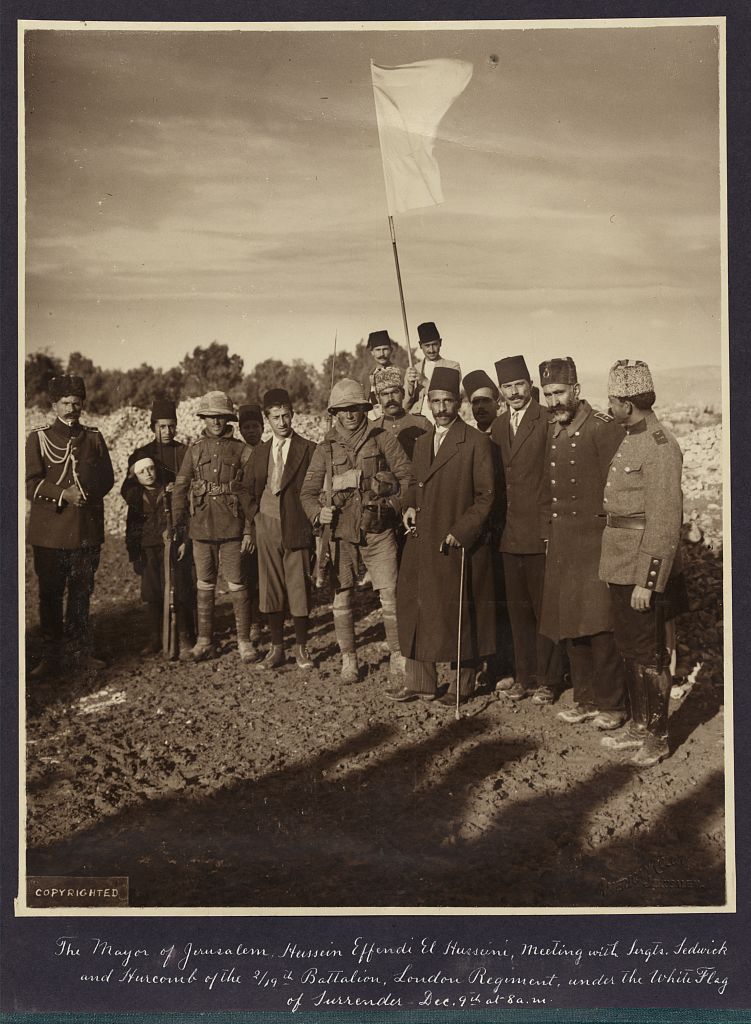
The formal surrender of Jerusalem. Handwritten caption: “The Mayor of Jerusalem Hussein Effendi El Husseini meeting with Sergeants Sedwick and Hurcomb [of the] London Regiment under the White Flag of Surrender, December 9, 2017.”
From Despair to Deliverance
In late November 1917, the Jewish women, children, and elderly men were still huddled underground, all too despairingly aware, as Ḥemdah Ben-Yehudah writes, that soon it would be Hanukkah: “the Feast of Deliverance in former days, and now approaching as the day of destruction!”
The women, weeping, prepared the oil for the sacred lights, and even the men wept, saying that this would be the last time they should keep the feast in Jerusalem! They strained their ears to hear the horses’ hoofs and the tread of the [Turkish] soldiers coming to arrest them and drive them forth. The women pressed their children to their breasts crying: “They are coming to take us!”
Then, suddenly, other women came rushing from outside down into the depths, crying: “Hosanna! Hosanna! The English! The English have arrived!” Weeping and shouting for joy, Jews and Christians, trembling and stumbling over one another, emerged and rushed forth from the caverns and holes and underground passages. Pious Jews uttered thanksgivings to the Lord God of Hosts who had wrought deliverance in this great historic day, in the very hour of the beginning of Hanukkah, the Feast of the Miracle of Lights.
On the first day of Hanukkah [November 27], the [advance] troop of English conquerors entered, shared their own bread with the famished populace, and offered the support of their hands to the feeble and the aged. On the following day, when the great English army entered the city, the women threw themselves on the necks of the soldiers, calling for the benediction of heaven upon them. Young women kissed the hems of their garments, and children threw flowers on their path.
* * * * *It was an impulse of life after the reign of death. The first to obey this overwhelming impulse were Jewish youths, the remnant that had been concealed hidden like the seed in the earth and had thus escaped the general persecution. These young men demanded the privilege of fighting side by side with the English, in the conquest of their own country. Their desire was granted. A battalion of native Jews was immediately enlisted, and the [numbers of] recruits increased.Fighting continued for more than a week afterward, but by December 9, 1917, the mayor of Jerusalem formally surrendered, and two days later General Allenby entered the Holy City on foot.
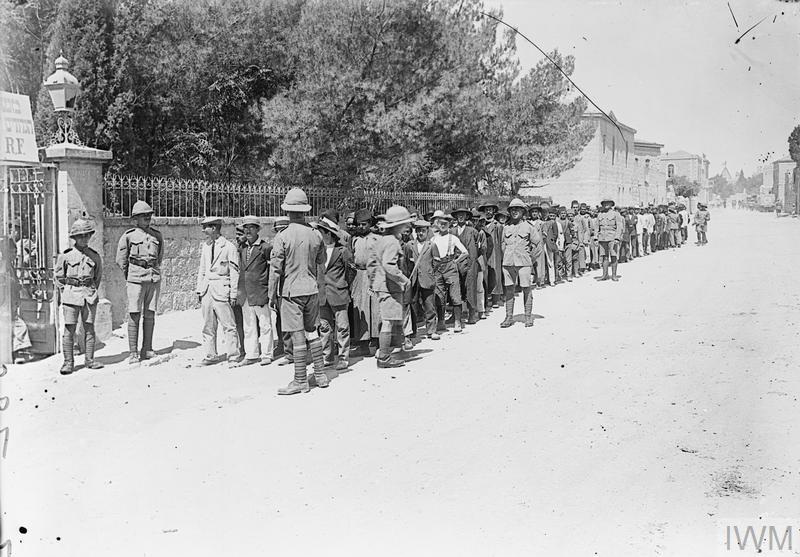
 Jewish recruits for the 40th (Palestine) Battalion, Royal Fusiliers in Jerusalem, summer 1918. Imperial War Museum Q 12670.
One Year Later
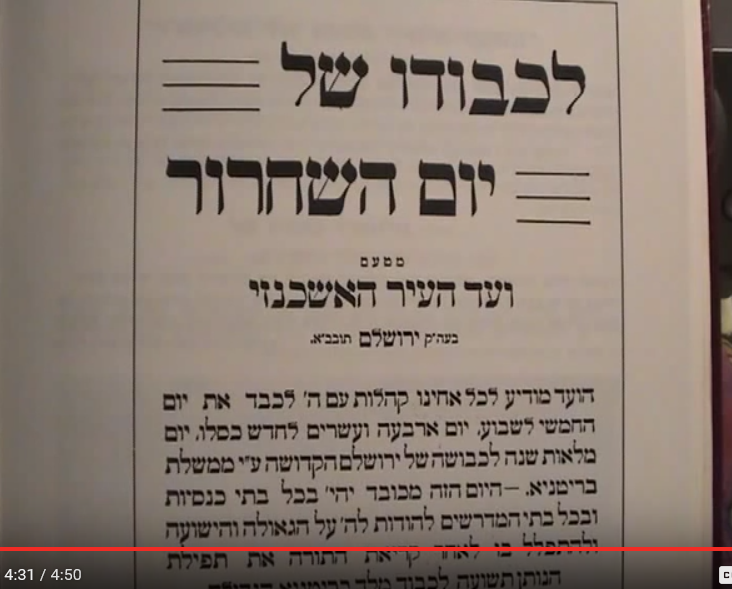
In November 1918, the Ashkenazi City Council, a precursor of today’s Eydah Ḥaredit, posted a notice of ceremonies marking the first Jerusalem Liberation Day in all synagogues and study halls and expressing thanks to the government of Britain:
 Screen grab taken by the author from a vintage newsreel.
In honor of Liberation DayFrom the Ashkenazi City Council in the holy city of Jerusalem, may it be rebuilt soon, Amen.
The Council calls upon our brethren in the congregations of God’s people to honor Thursday, the 24th day of Kislev, the first anniversary of the capture of Holy Jerusalem by the government of Britain. On this honored day, all synagogues and study halls should thank the Lord for His redemption and salvation and, after the Torah reading, recite the prayer “Who givest salvation” for the king of Great Britain [after Psalm 144: “Who givest salvation unto kings, who rescuest David Thy servant from the hurtful sword”].
An official British military report on the Jerusalem victory, likening the 1917 liberation to the defeat and ouster of the Seleucid Greeks by the Maccabees, and attributed by some to General Allenby himself, appears in several sources:
On this same day, 2,082 years before, another race of conquerors, equally detested, were looking their last on the city which they could not hold, and inasmuch as the liberation of Jerusalem in 1917 will probably ameliorate the lot of the Jews more than that of any other community in Palestine, it was fitting that the flight of the Turks should have coincided with the national festival of the Hanukkah, which commemorates the recapture of the Temple from the heathen Seleucids by Judas Maccabæus in 165 B.C.Tragically, such British concern for the Jewish people did not last.
Two decades later, in the mid-1930s, the British Mandate government shut the gates of Palestine to European Jews desperate to escape Nazi Germany. But by 1948, with the establishment of Israel, and by 1967, with the victories in the Six-Day War, the Jewish people was firmly on the path of national redemption.


 This week's Prophetic TV e-blast includes videos from: